
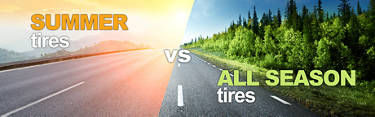
Tire categories can be confusing, and many drivers can’t distinguish the difference between an all-season or a summer tire. But when it comes to maximizing your vehicle’s performance for your driving conditions, choosing the right tire becomes incredibly important. We’ve explained the differences between summer and all-season tires below.
You can also use Treadwell, our smart tire guide, to help find the best tires for you, your vehicle, and your drive.
WHAT ARE SUMMER TIRES? PERFORMANCE & FEATURES EXPLAINED
Summer Tires Quick Facts
Wet and dry condition performance
Designed for warm weather only
Higher speed ratings, ideal for performance vehicles
Wide tread, deep grooves for hydroplane resistance
Soft compounds
Short lived tread
Can be noisy/not as comfortable
Summer tire performance offers superior traction and shorter braking distances in warm conditions, hence their name. Summer tires are engineered with softer rubber compounds than other tire types. This boosts grip and handling in warm, dry or wet conditions.
It is a misconception that summer tires are only suitable for dry conditions. Many tire manufacturers are focusing on wet condition treads for the summer months. Summer tires generally have a wider contact patch and more circumferential grooves compared to all-season tires to boost hydroplane resistance.
Summer tires tend to be aimed at performance vehicles and do not typically have long-wearing treads.They do not perform well in cool temperatures at or below 45F.
WHAT ARE ALL-SEASON TIRES? BALANCED PERFORMANCE ALL YEAR
All-Season Tires Quick Facts
Designed for mildest conditions in every season
Not meant for winter driving
Versatile design
Summer, touring, and winter tread elements
Specialized compounds for long-lived service
All-season tires are the most popular tire category thanks to their versatility. They offer good performance in the mildest conditions of every season. They blend summer, winter, and touring characteristics to offer competent traction and handling in a wide range of conditions, including rain, shine, and very light winter weather.
All-season tires feature deep grooves and specialized tread compounds to support longer treadwear, a smoother ride, and reliable traction. Compared to other tire types, they last a long time.
In warm conditions, summer tires perform better than all-season tires. However, all-season tires perform better in cooler or light winter conditions.
Due to its name, many drivers believe that all-season tires are good for year-round driving in all weather conditions. However, this is untrue as they do not do well in true winter conditions (temps below 45F, snow, ice, slush). All-season tires trade longevity for cold weather condition performance.
America's Tire recommends switching to a dedicated winter tire if your region experiences true winter conditions of consistent temperatures at or below 45F, regardless of the presence of snow or ice.
SUMMER TIRES VS ALL-SEASON TIRES: SIDE-BY-SIDE COMPARISON
Below is a handy summer vs all-season performance comparison table.
| Feature | Summer Tires | All-Season Tires | Notes |
|---|---|---|---|
| Temperature Range | Warm, hot | Year-Round (mild Temps) | Both cannot handle below 45F; Excessive high heat can shorten all-season lifespans |
| Dry or Wet Traction | Excellent | Great | Summer tires have better dry and wet traction |
| Winter Weather Traction | Poor | Good | All-season tires can handle mild winter conditions but are not great for true winter regions |
| Tread Life | Short | Long | Summer tires are expected to be used in warm climates and will typically wear faster than all-season tires. |
| Comfort & Noise | Sporty but loud | Smooth and quiet | Can vary by tire model |
How To Choose Between Summer and All-Season Tires (Decision Guide)
When it comes to choosing between summer or all-season tires, keep the following in mind:
1. Local climate and weather
All-season tires tend to be the most practical for the majority of the United States but warmer climates in the Southwest and Southeast can maximize performance with summer tires.
2. Driving style and vehicle type
Performance or sport car owners will benefit from summer tires while daily commuters of any other vehicle type may prefer all-season versatility.
3. Budget, tread life, and long-term costs
You should factor in your budget, how long you want your tires to last, and storage into account. Summer tires may need to be swapped for other tires later in the year and require proper storage. All-season tires will also need to be swapped for winter tires in winter regions.
Winter Tire Changeover ServiceAmerica's Tire offers tire storage in some regions. Check to see if your local store offers our Tire Hotel amenities.
Tire Hotel ServiceSummer Vs All Season Tire FAQ
It’s not recommended to use summer tires year-round unless you live in a warm climate. Keep in mind that they do not last as long as other tire types so you will need to replace them more frequently.
All-season tires can be good in rain and light snow, but are not ideal for moderate or severe weather conditions.
Yes, summer tires typically wear faster than all-season tires due to their softer tread compounds and overall shorter tread life.
Ready to roll?
If you have any questions or are unsure what tires work best for you, drop in or give us a ring. We’ll get you taken care of. Buy and book online and save time in-store!
For more information on this and other tire and wheel services, check out our YouTube Channel or reach out to us on X, Facebook and Instagram.